 I swear there was a time when I could make paper airplanes that flew, but that time has clearly passed. So I got a book on making paper airplanes (recommended by friend of the lab Arthi). We were able to make a bunch of really cool airplanes (some of which actually took decent flights). Although I got this book for Jr. scientist A, I was surprised at how much fun the younger Jr scientist E had watching the airplanes fly by. She eventually started toddling over to where they fell and bringing them back for another flight. We had a lot of fun seeing how different designs and different modifications resulted in different flight patterns (I have to confess that I started making two of each design because I wanted more turns!). At some point, Jr. scientist A must have decided that the planes were flying because they were made of paper and insisted on trying to fly an (unmodified) paper bag. This isn't the first time that he's gone from observer/participant to actively guiding experiments in new directions, and I have to say I'm a bit proud of that!
Wednesday, January 4, 2012
High flying fun
I swear there was a time when I could make paper airplanes that flew, but that time has clearly passed. So I got a book on making paper airplanes (recommended by friend of the lab Arthi). We were able to make a bunch of really cool airplanes (some of which actually took decent flights). Although I got this book for Jr. scientist A, I was surprised at how much fun the younger Jr scientist E had watching the airplanes fly by. She eventually started toddling over to where they fell and bringing them back for another flight. We had a lot of fun seeing how different designs and different modifications resulted in different flight patterns (I have to confess that I started making two of each design because I wanted more turns!). At some point, Jr. scientist A must have decided that the planes were flying because they were made of paper and insisted on trying to fly an (unmodified) paper bag. This isn't the first time that he's gone from observer/participant to actively guiding experiments in new directions, and I have to say I'm a bit proud of that!


Friday, December 30, 2011
Fizzy colors

Looking for a good experiment for Jr. scientist E, at my wife's suggestion I went back to an old fizzy standard - mixing baking soda and vinegar. To make it more interesting, I put down a drop of red food coloring and a drop of blue food coloring, with the baking soda and vinegar in the middle. As the fizzy mess spread, it took up the food coloring. Jr. scientist E just stared intently at the bubbly concoction (I think with interest!), getting transfixed each time I added more baking soda or vinegar to restart the fizzing.
Ice melting experiment
We had previously used salt to briefly drop the melting point of ice. This time we tried it on a larger scale. We made two ice cubes. The first one (red in the video) was made using water that had Epsom salt dissolved in it. The second one (green in the video) was made using plain water. This wasn't exactly the cleanest experiment - the plain water cube ended up noticeably bigger and was frozen for a shorter period since we already had salt ice cubes sitting around - part of a long-term experiment I'll write about when it's finished. But I expected the effect to be large enough that the general results would be unaffected. As shown in the video, the salt ice cube did melt much faster (about half an hour compared to 1.5 hours for the albeit larger plain water ice cube). You can see from the pool around the edge of the plate how much quicker the salt ice cube was melting. The two ice cubes also melted in very different ways. The plain water cube primarily just got smaller. It still had the typical smooth edges of an ice cube. The salt ice cube started looking very rough and "eaten away" even though it started out smooth. The one oddity was that the plain water ice cube started melting much quicker. We may need to do a more controlled experiment. Although Jr. scientist A enjoyed watching the ice cubes melt, I was surprised that he showed little interest in the sped up video, which I thought would be easier for him to grasp.
Monday, December 26, 2011
Good clean fun
 Today we did an experiment that Jr. scientist A named the messy messy experiment. We made some bubble mix (water + dish detergent)and headed outside to play with bubbles. We used a funnel to make different sized bubbles (depending which end we blew into) and tried out a new bubble maker -two straws connected with string- with mixed results. The experiment ended with playing around in puddles of bubble mix and lots of fun.
Tuesday, December 6, 2011
Hand-crank flashlight

After getting a hand-crank flashlight at the store, we decided to try to build our own mini version. We used a small electric motor and a couple LEDs. When we manually spun the motor (using it like a little power generator), the LED lit up, much to jr. scientist A's delight. Even cooler, when we had the two LED lights connected with opposite polarity (switching where the positive lead went), one would light up when we spun the motor in one direction and the other would light up when we spun the motor in the opposite direction. Very cool experiment.
Monday, September 26, 2011
Growing corn, a summary
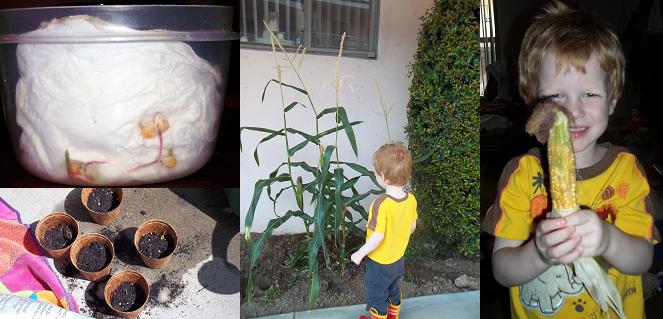
Our corn growing experiment is finally at an end. We went from popcorn kernel to ears of corn. I have to admit I didn't imagine that we would actually pull this off. We knew almost nothing when we started - even mistaking the flowering part of the corn stalk for the corn - but with a lot of luck (and some research along the way), we actually grew corn. Jr. scientist A loved watching his corn grow and get taller than him. He was so excited when we got to pick the first ear of corn - he wanted to tell everyone! Now what can we try to grow next year?
Sunday, September 4, 2011
Mentos-powered fountain

I've been wanting to do this one for awhile. We added mentos to diet coke and got a big fountain of cola. We tried to add 4 mentos but couldn't get more than 3 in before the fountain started (I had also hoped to get far away before it went off, but oh well). Jr. scientist A really liked this one. Jr. scientist E also joined us for her first experiment, but I think it was too fast (a few seconds in total) for her to notice.
Subscribe to:
Posts (Atom)