
Showing posts with label long term. Show all posts
Showing posts with label long term. Show all posts
Tuesday, October 16, 2012
Why does yeast make dough rise


Monday, March 26, 2012
Colorful cauliflower

Saturday, January 28, 2012
Separating colors

Wednesday, January 18, 2012
Stalagmites and stalactites, take 3

Monday, September 26, 2011
Growing corn, a summary
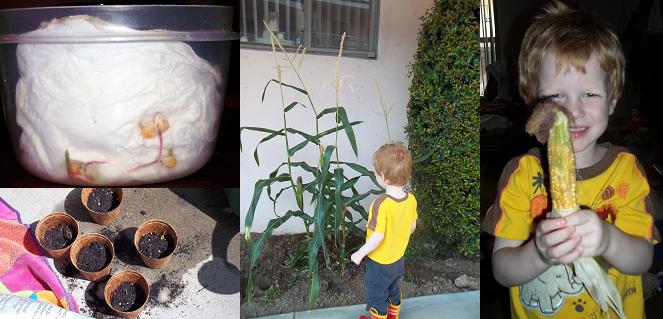
Our corn growing experiment is finally at an end. We went from popcorn kernel to ears of corn. I have to admit I didn't imagine that we would actually pull this off. We knew almost nothing when we started - even mistaking the flowering part of the corn stalk for the corn - but with a lot of luck (and some research along the way), we actually grew corn. Jr. scientist A loved watching his corn grow and get taller than him. He was so excited when we got to pick the first ear of corn - he wanted to tell everyone! Now what can we try to grow next year?
Thursday, June 2, 2011
From seedling to plant

We planted our seedlings that we grew from popcorn kernels. We had a fun time filling biodegradable pots with soil, sticking in the seedlings, and planting the pots. I wasn't really sure if they'd survive the transplant, but we dutifully watered them every day. Within a few days we started seeing little plants poking out of the soil. Since then they've just kept growing and growing. It's neat to see what our little popcorn kernels are turning into. We're now working on trying our hand at baby carrots.
Wednesday, May 18, 2011
From seed to seedling

After a few fun trips to our local plant nursery, I thought it would be neat to show jr. scientist A. how a seed turns into a plant. We took a plastic container and lined the inside wall with a damp paper towel. Then we stuck a few popcorn kernels between the paper towel and the wall of the container. With dutiful watering to make sure the towel stayed damp and a nice sunny windowsill, we started to see some sprouting in a few days. A few days after that there were little purple roots climbing downwards and little greet shoots climbing upwards - how do they know how to do that! Tomorrow we're planning on transplanting our seedlings to a dirt pot to let them grow bigger.
Thursday, April 21, 2011
Raising a butterfly

Our local kids museum has an annual adopt-a-caterpillar event. You get a very tiny caterpillar to take home in a small container. Over the course of a couple weeks you get to see it get bigger and bigger. Then, as jr. scientist A liked to recite, it would "build a cocoon, stay inside for two weeks, push its way out and be a beautiful butterfly!" (the last two words were always said loudly with arms up in the air). It was a really neat experience, although jr. scientist A was sad when we released our little friend into the wild.
Tuesday, April 12, 2011
Meeting in the middle

Time for more fun with food coloring. We had previously used two colors to see whether salt water was slower to diffuse than fresh water. This time we repeated the experiment with two containers of differently colored fresh water. To our surprise, although the colors eventually seemed to meet in the middle, the red took days longer than the yellow color. It seems that whatever makes the different colors causes them to diffuse at different rates. We'll have to play around with that some more.
Friday, April 1, 2011
Crystal growing mediums

Since our previous attempts at growing stalactites have yet to yield anything remotely resembling a stalactite, we decided to take a step back and do some pilot experiments. There seems to be a few problems that potentially need to be addressed. 1) How do you get a nice slow drip for the salt water so that the crystals can grow over time? 2) What type of materials will the stalactites grow best on? 3) How do you refill your salt water solution without dissolving the already formed (water soluble) crystals (i.e., whatever makes the slow drip has to either never release the solution faster than a drip or be detachable)? I'm sure there's a few more we'll run into.
We've previously made some good progress on the first problem. We decided to attack the second problem by trying to grow crystals on different materials. We made our crystal solution, dissolving as much salt as possible in super heated water. This time we used table salt - nice and safe to handle and eat (good for a toddler hands-on experiment, that is, once the water has cooled). We poured the crystal solution over cardboard, paper, wood (a popsicle stick), and wool yarn. We set the materials in a window for a couple days and then checked on our results. The crystals grew everywhere (including on the plastic container the materials were in), but they just looked like big grains of salt on most of the materials. The one that stood out was the yarn (shown above, enlarged). There it seemed to form large crystal structures that looked like they'd be ideal for the beginnings of stalactites. I think we found our crystal growing medium!
Friday, January 21, 2011
Water race

To try to show that, even though water looks the same after you dissolve salt in it, it's changed, we decided to compare the speed of diffusion for salt water and fresh water. We filled one bottle with fresh water, dyed green, and a second bottle with water with Epsom salt dissolved into it, dyed red. Then we rolled up a paper towel and put an end in each bottle. The green fresh water started climbing the paper towel. At first it looked like the red salt water was just sitting there, but we checked and the un-dyed paper towel coming from the red was wet, while the paper towel from the fresh water was only wet where it was green. Eventually the red color started moving along the towel. It looks like the salt slowed the diffusion of the color, but not the diffusion of all the water.
Thursday, January 20, 2011
Making water run upstream

We decided to try to make water run upstream, so to speak, using diffusion. We filled a bottle with colored water. Then we took a long piece of paper towel, rolled it up, and used string to keep it rolled up. We put one end of the paper towel in the water-filled bottle and the other end in an empty bottle that we put on a raised platform. Nearly instantly the colored water started creeping up the paper towel. We quickly learned that a paper towel saturated with water is much heavier than a dry paper towel and we had to add supports to hold the paper towel up. Throughout the evening we watched its slow progress. We checked on it in the morning and, to our surprise, the water hadn't made it all the way to the other bottle. Instead, it stopped part-way up, leaving a dark ring of color, followed by dry paper towel. I guess diffusion will only go so far.
Thursday, January 13, 2011
Stalagmites and stalactites, take 2

Our second attempt at making stalagmites and stalactites with salt crystals. This time we used a paper towel to connect the two jars filled with Epsom salt dissolved in water. The liquid did slowly travel up and across the paper towel, making the paper towel rigid, and we got some crystals forming below the paper towel, but nothing that looked like stalagmites or stalactites. We'll have to keep trying.
Friday, December 31, 2010
Making paper

For this experiment we turned paper into... paper. We started with some old newspaper and magazine pages and tore it into shreds (Jr. scientist A. is so good at doing that with paper he's not supposed to tear, but seemed unwilling to do it when he had permission!). We put the paper and some hot water in a blender, let it sit for 20 minutes, and then blended it into a watery mixture. We poured the mixture over a silk screen that was placed over a bin lined with a garbage bag. We then added leaves and a pressed flower we had collected on walks and pressed out some of the water. We let it sit in the sun, periodically pressing out more water. We eventually learned to put wax paper on top of the mixture before we pressed out the water after we kept pulling off parts of the "paper." After a day, it had dried and we carefully peeled it off the screen. We were left with (somewhat delicate) paper that had some of the leaf patterns pushed into the back side. A fun, albeit slow project.
Saturday, December 25, 2010
Sun bleaching in the rainy season

We did some more sun bleaching - this time making sure everything was firmly attached to prevent the cats from interfering. It ended up raining and raining and raining for days in a row, making it take more days than usual. In the end it turned out pretty well. Jr. scientist A. wanted me to cut out the rectangle to carry around and then was surprised that, without the surrounding bleached out paper, it just looked like an ordinary sheet of construction paper.
Sunday, December 19, 2010
Growing crystals

We tried to make crystals by dissolving Epsom salt in water. We heated water up in the microwave (so we could dissolve the salt at the table in plain view). After we dissolved as much salt as we could (with some undissolved salt sitting at the bottom of the cup) we microwaved it again. This dissolved the remaining salt and let us mix more in. We repeated this a couple times, added food coloring, and poured a shallow layer of the solution into a tupperware container. After letting it sit a couple days so the water could evaporate, we were left with some rather unimpressive crystals. It was essentially a somewhat sparkly layer of material. We'll have to work on making better looking crystals.
Subscribe to:
Posts (Atom)