Friday, December 31, 2010

Making paper


For this experiment we turned paper into... paper. We started with some old newspaper and magazine pages and tore it into shreds (Jr. scientist A. is so good at doing that with paper he's not supposed to tear, but seemed unwilling to do it when he had permission!). We put the paper and some hot water in a blender, let it sit for 20 minutes, and then blended it into a watery mixture. We poured the mixture over a silk screen that was placed over a bin lined with a garbage bag. We then added leaves and a pressed flower we had collected on walks and pressed out some of the water. We let it sit in the sun, periodically pressing out more water. We eventually learned to put wax paper on top of the mixture before we pressed out the water after we kept pulling off parts of the "paper." After a day, it had dried and we carefully peeled it off the screen. We were left with (somewhat delicate) paper that had some of the leaf patterns pushed into the back side. A fun, albeit slow project.

Thursday, December 30, 2010

Stalagmites and stalactites


After visiting a cave exhibit at the zoo, we decided to try to make our own stalagmites and stalactites. We dissolved as much Epsom salt as we could into hot water and divided it into 4 empty baby food jars. We added different food color to each jar and then hung strings between them - some wool and some cotton. Each string was weighted down on either end with a paperclip. The idea was that the water/salt mixture would go along the strings and drop down near the middle where the strings dipped a little. Over time, this should cause some crystals to grow down from the string where the water was dripping from and grow up from the container where the water dripped to. Unfortunately, the liquid never made it up any of the strings, so we never got any stalagmites and stalactites. However, crystals started growing both around the rim of the jars and on the outside sides, and even around the outside base of the jars! We didn't expect that - and it saved our experiment from complete disaster.

Wednesday, December 29, 2010

Rocket balloon


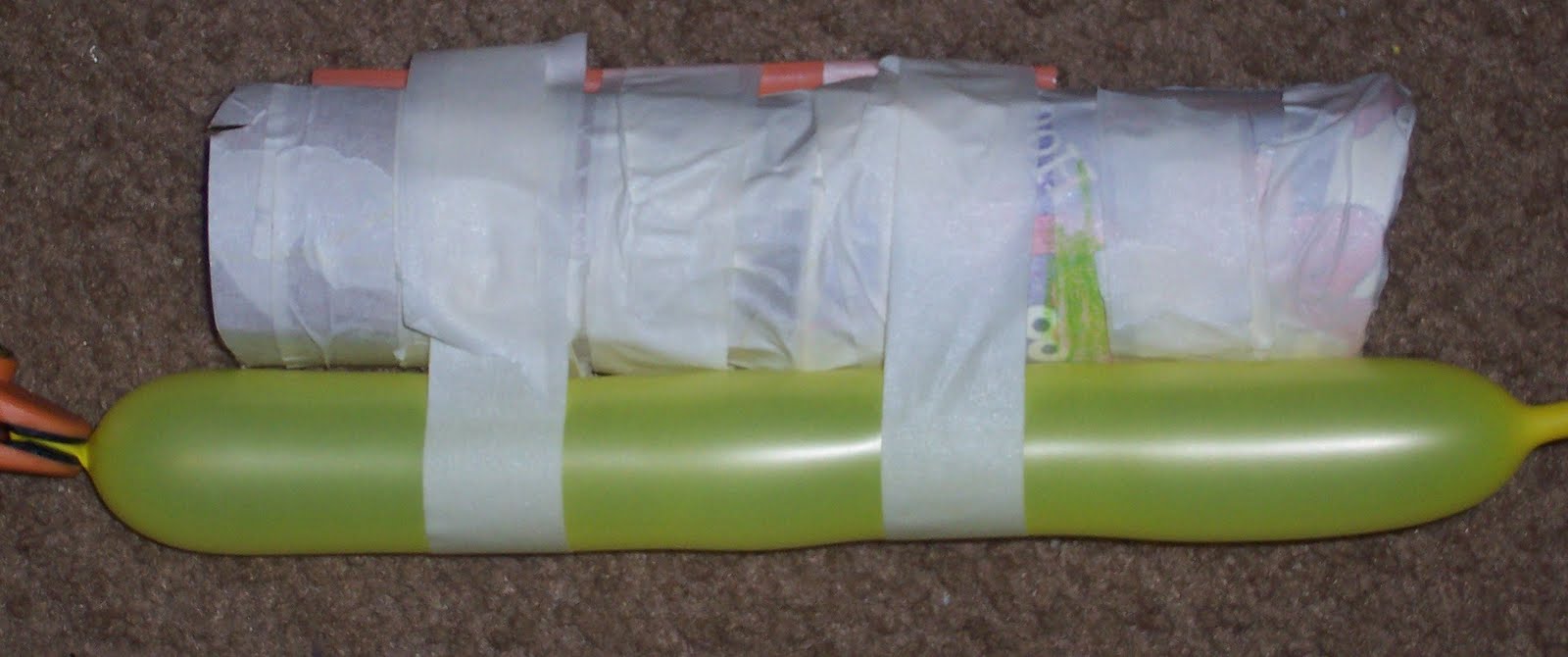
This should work. Inflate a balloon, attach it to a straw with a tethered string running through it, and when you let the air go out of the balloon, the "rocket" should be propelled along the string. But despite various different rocket "designs," we haven't been able to get this to work. We've tried taping a big balloon directly to the straw with packing tape (the balloon may move a little along the rope but not very far - and re-inflating the balloon tends to make it pop because of the tape stuck to it), attaching a paper towel tube to the straw and sticking a long thin balloon into it (the rocket doesn't move at all), and taping a long skinny balloon to the bottom of the paper towel tube (again, basically no movement). Maybe it's not enough force, maybe the pressure is not being well directed. All I know is we can't seem to get this experiment to work. How frustrating!

Tuesday, December 28, 2010

Messy experiments


We made a couple of bubbly chemical reactions today. Jr. scientist A's prediction: "It's gonna be messy." For our first reaction, we mixed hydrogen peroxide and active dry yeast. This made big bubbles (left picture) that raised up in a high column before the column eventually fell over. For our second reaction, we mixed baking soda and vinegar and got much smaller bubbles that quickly ran over the edge of the container (right picture). Jr. scientist A. liked these experiments a lot.

Sunday, December 26, 2010

Making things sink on command


Today we played with surface tension. We dropped a loop of yarn onto a bowl of water and it floated. We then added some drops of dish detergent, breaking the surface tension, and the yarn sank to the bottom. We repeated the experiment with a few other objects. A twisty-tie floated until we added the detergent. A paperclip sank right away - oops too heavy. Paper floated, even after we added detergent, but sank to the bottom when we pushed it under water. A cork floated no matter what we did. Its buoyancy amused jr. scientist A.

Saturday, December 25, 2010

Sun bleaching in the rainy season


We did some more sun bleaching - this time making sure everything was firmly attached to prevent the cats from interfering. It ended up raining and raining and raining for days in a row, making it take more days than usual. In the end it turned out pretty well. Jr. scientist A. wanted me to cut out the rectangle to carry around and then was surprised that, without the surrounding bleached out paper, it just looked like an ordinary sheet of construction paper.

Thursday, December 23, 2010

Clanking coin


We tried an experiment from 365 More Simple Science Experiments with Everyday Materials. The idea is that if you put a bottle in the freezer, it fills with cold air. When you take the bottle out of the freezer, the air inside the bottle warms up and therefore expands. If you block the way out for the expanded air, it will cause pressure to build up behind the blockage.

We first tried with a plastic bottle, putting it in the freezer for 5 minutes. We took it out, put a wet quarter over the bottle opening, and waited. Unfortunately nothing happened. We tried a glass bottle with a smaller opening, thinking the quarter wasn't fully blocking the mouth (or that the sound of a quarter on plastic wasn't very noticeable). The quarter did lift up and clank back down as pressure built up and was released in the warming bottle . However, there was a long time between clanks. We tried cooling the bottle overnight to make sure the air inside was very condensed. This worked well. We got lots of clanking, one after the other. Jr. scientist A. got quite a kick out of it.